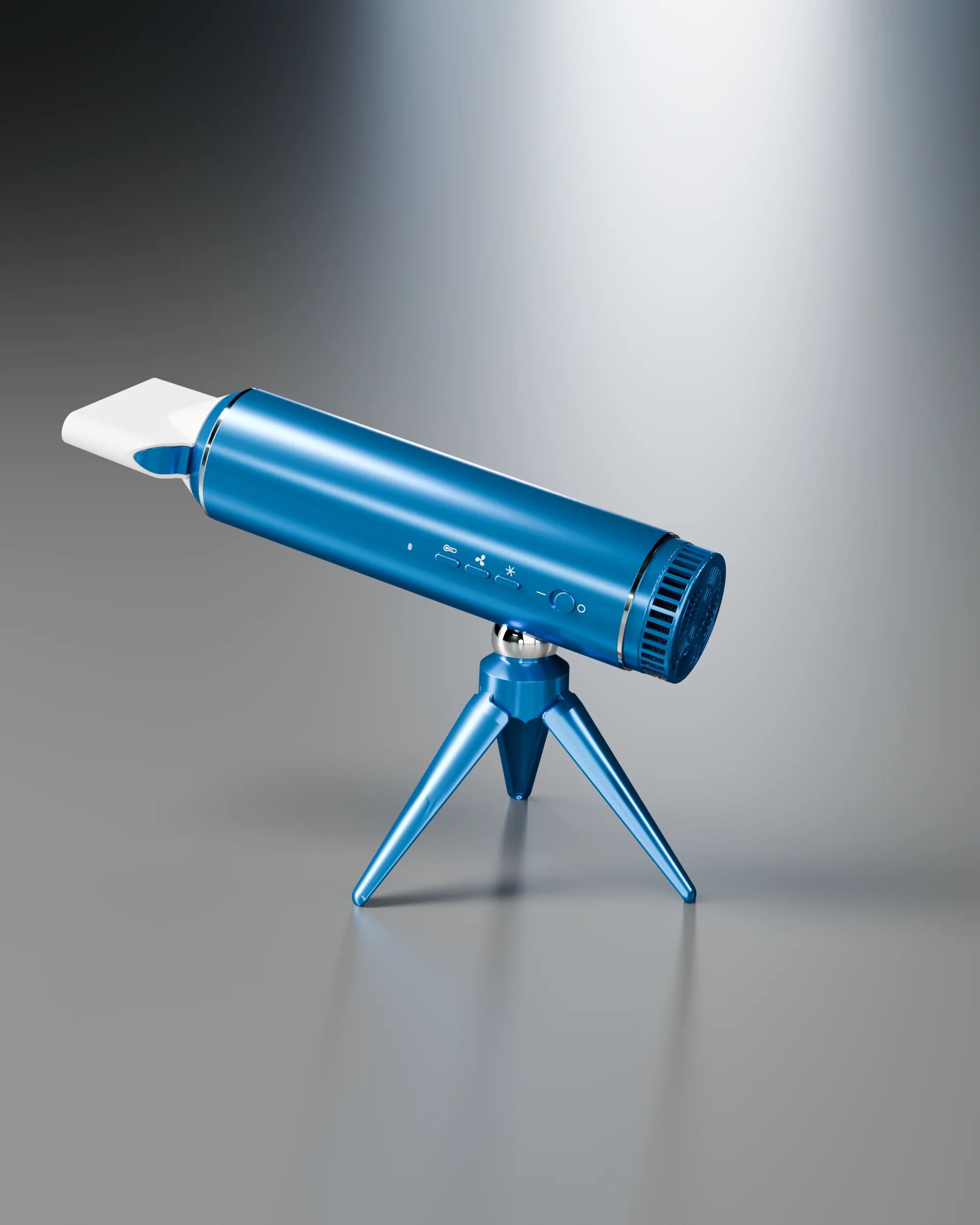
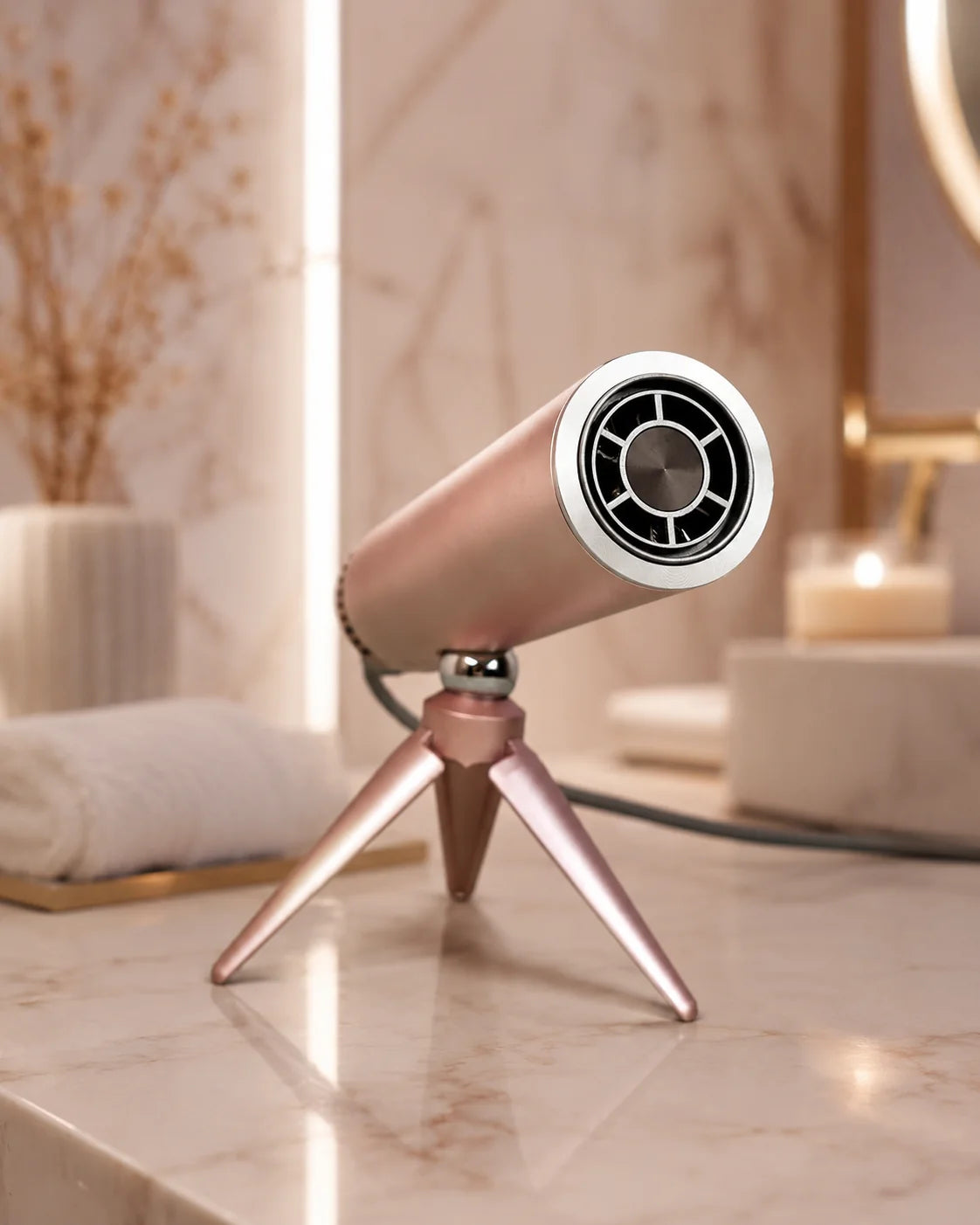
HandsFreeDryer has evolved — meet LUNAR
Every object in your bathroom has a history, but the hair dryer's is a strange one: 130 years of genuine innovation — in motors, in materials, in airflow — built on one assumption nobody thought to question. That you would hold it.
1890: the seated salon machine
The first hair dryer wasn't handheld at all. Alexandre-Ferdinand Godefroy's 1890 Parisian invention was a seated hood — a bonnet connected by pipe to a heat source, under which a client sat while the machine did the work. Slow and clunky, yes. But notice something: the very first dryer in history was hands-free. Godefroy understood instinctively that drying takes minutes, and nobody should spend those minutes holding something.
1920s: the dryer comes home — and into your hand
The handheld dryer arrived in the 1920s, and it was a commitment: early models were built from steel and zinc, weighed close to a kilogram, and produced modest heat with feeble airflow. Drying took ages, and your arm was the tripod. The trade-off made sense at the time — portability was the revolution, and the hood stayed at the salon.
What's remarkable is how long that trade-off went unexamined. Plastics in the 1960s made dryers lighter. The 1970s and 80s brought better safety and the bonnet's brief home comeback. But the core deal — your hand is the stand — survived every redesign.
2016: the premium arms race
Then came the era you've lived through. A famous vacuum company put a tiny digital motor in the handle, priced it like a smartphone, and proved people would pay real money for a fundamentally better dryer. Competitors followed with smarter heat control and cleverer airflow. Genuinely impressive engineering — the modern premium dryer is faster and gentler than anything before it.
And yet. Watch someone use a €400 flagship dryer and you'll see the same posture as 1925: one arm raised, aching by minute five, drifting closer to the head as it tires. The industry made the dryer brilliant. It never made it let go.

The question that started LeLunar
The idea behind the LUNAR dryer came from asking the 1890 question again, with 2020s tools: what if the machine held itself — without chaining you to a chair under a hood?
The answer is a dryer built around a magnetic tripod mount. Snap it onto the stand and it becomes Godefroy's dream in modern form: a steady airflow source at exactly the height and angle you set, while you sit comfortably and turn your head through the air — both hands free for a round brush, for sectioning clips, for your phone, for nothing. Pull it off the stand and it's a normal handheld dryer, anodized aluminum and familiar in the hand, for the quick blast days.
That dual nature matters more than it sounds. Every previous attempt at hands-free drying asked you to choose — the hood chair or the handheld, convenience or control. The LUNAR's bet is that the choice was always false: the same machine can be both, and the stand is where it lives most mornings.
Why this matters beyond convenience
Everything we publish on this site — the 15 cm rule, constant motion, drying down the strand, sectioning with two hands — quietly assumes a steady dryer and free hands. For a century, that assumption held only in salons, where the stylist's trained arm was the stand. A mounted dryer moves the assumption into your bathroom. Technique stops being a skill and becomes a setting.
And for people with shoulder pain, arthritis, or limited mobility, it's not a refinement at all — it's the difference between doing your own hair and not. That might be the most honest way to describe where the hair dryer's evolution has arrived: after 130 years, the machine finally does the holding, and the human is free to do the styling.
Godefroy would recognize the idea immediately. It just took the rest of us a century to circle back to it.